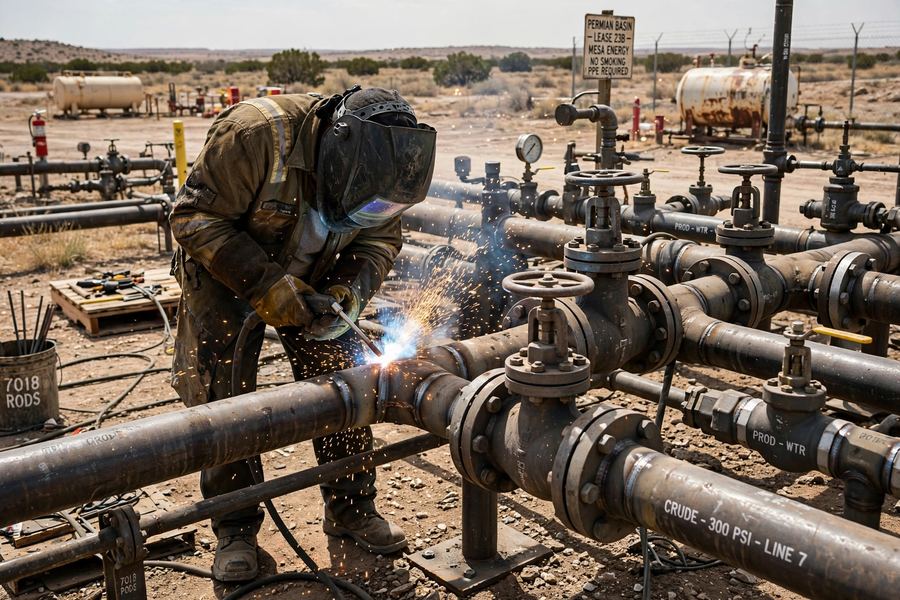
Oilfield Welding in the Permian Basin

When a flowline parts at 2 a.m. or a tank battery fitting cracks during a frac, you don't need a shop quote — you need a welder who rolls. Permian Mobile Welding brings the truck, the machine, and experienced welders to your lease, yard, or rig site anywhere in the Permian Basin, 24/7.

Mobile oilfield welding on rig and production equipment in the Permian Basin

Downtime is the real cost

A shut-in well doesn't care that your regular shop opens at eight. Every hour a production line sits down is barrels not moving or a frac crew standing around at day rates that dwarf a welding callout. Out here the best weld is the one that holds — and the one that gets there now.

That's the whole job we built this company around. We're a mobile outfit, not a building with a counter. Our rigs carry diesel welders, torches, gouging equipment, and the fittings and plate to fix most problems without a parts run. When you call, you talk to someone who knows the difference between a sales line and a flowline, who asks the right questions the first time, and who shows up ready to burn rod — not to inspect and reschedule. One-off repairs, turnaround support, or recurring maintenance — if it's steel on a lease and it needs a welder, it's our trade.

What we weld on the lease

  • Tank batteries — line repairs, thief hatch and gauge pole fixes, walkway and stair repairs, battery piping, containment and load-line work.
  • Flowlines and production lines — cracked welds, corrosion cut-outs, tie-ins, and line re-routes on production piping.
  • Rig and workover repairs — substructure cracks, stairway and handrail damage, mast and derrick member repairs, mud tank and reserve pit hardware.
  • Compressor stations — skid repairs, pipe supports and hangers, discharge line fixes, platform and access steel.
  • Pumpjack and pumping unit repair — horsehead and beam cracks, base and skid repairs, guards, and counterweight hardware.
  • Wellhead and cellar work — conductor and cellar repairs, riser supports, walkway grating, and wellhead platform steel.
  • Separators and vessels — non-code structural repairs: saddles, skirts, supports, ladders, and platforms (we are not a pressure-vessel shop).
  • Pipe racks and racks — fabrication and repair of pipe racks, catwalk steel, and laydown-yard structures.
  • Truck beds and trailers — cracked beds, bent hinges, headache racks, fifth-wheel plate repairs, and trailer frames for lease traffic.
  • Lease-road hardware — cattle guards, gates, fencing steel, and sign posts.
  • Flare lines and stacks — supports, braces, and access steel for flare and vent systems.
  • General lease steel — if it bolts, stands, or holds pipe on your lease, we've probably welded it before.

Processes, materials, and how we show up

Field welding out here is overwhelmingly stick work. Our primary process is SMAW (stick) — 6010 root and hot pass, 7018 fill and cap on carbon steel — because that's what holds up to inspection on production piping and structural repairs in the wind and dust. We also run MIG/FCAW (flux-cored) for high-deposition fabrication, plus oxyfuel and plasma cutting and carbon-arc gouging for crack removal.

Materials are mostly carbon steel — A36 structural, A500 tubing, and line-pipe grades like API 5L X-42 through X-65. We stock common fittings, flanges, and plate on the truck, and we'll tell you straight on the phone if your job needs material we don't carry.

Lease work often runs through areas with H2S potential, and our crews follow oilfield lease protocol: checking in with the pumper on arrival, watching wind direction, and standing down when conditions aren't safe. If your site requires specific safety credentials, tell us up front and we'll confirm before we roll.

Straight talk on pricing: hourly, day rate, and callouts

Oilfield welding is priced the way the oilfield works. Here's how we do it:

  • Hourly for most repair calls — portal to portal, from when we leave the yard to when we're back, with a minimum callout that covers mobilization. Small jobs pay the minimum; that's honest and it's how every real oilfield welder prices.
  • Day rate for turnaround support, multi-day projects, or standby work where you want a welder dedicated to your site. Day rates beat hourly once you're past six to eight hours on location.
  • Upfront numbers before the arc strikes. On arrival we assess, we give you the number — labor plus any material — and you approve it before we strike an arc. No surprises on the invoice, ever.

What costs extra out here is distance and timing: a 3 a.m. callout 40 miles past the pavement runs more than a Tuesday-morning yard repair, and we'll tell you exactly what the emergency premium is before you say yes. What never costs extra is the phone call. Describe the break, send a photo if you can, and you'll get a straight answer. For recurring work, ask about standing arrangements — priority dispatch and agreed rates; see our 24/7 emergency welding page for after-hours terms.

How it works

1. Call us

Day or night. Tell us what broke, where it sits, and what it's holding — pipe, pressure, and product matter.

2. We roll out

We load for your specific job and head to the location. For Midland and Odessa area calls we're typically close; farther leases just take longer.

3. On-site assessment

We look at the break, check access and conditions, and give you an upfront number — labor and material — before any welding starts.

4. We weld

You approve the price, we weld, clean up, and you sign off. You get back to producing.

Get a fast quote

Tell us what broke and where it sits. We respond fast during business hours — and the phone is answered 24/7 for emergencies.

Prefer to talk it through? Call (432) 555-0100 — 24/7.

Call (432) 555-0100 — 24/7