Pipeline Welding in Midland, TX
Gathering lines, tie-ins, cut-outs, and repairs — pipeline welding is a different trade from general steel work, and we treat it that way. Our mobile pipeline welders come to your right-of-way or lease anywhere around Midland, Odessa, and the greater Permian Basin with the procedure discipline inspectors expect.
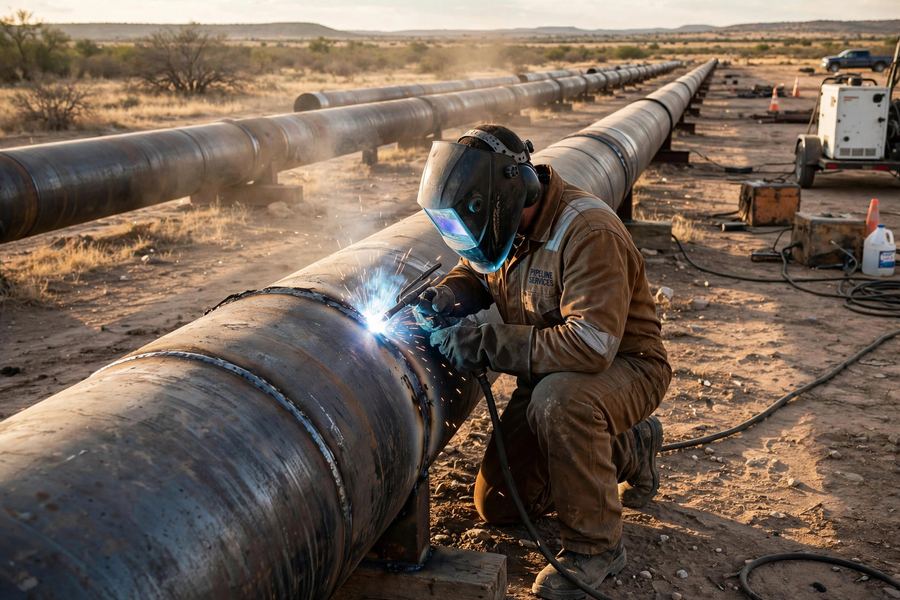
Line pipe has its own rules
A pipeline weld isn't judged by how it looks on the truck bed on the way home — it's judged by x-ray, by ultrasonic testing, or by the simple fact that it holds ten thousand barrels a day without weeping at the tie-in. Pipeline welding means consistent root penetration, controlled heat input, and a welder who can repeat the same procedure on joint after joint, in the ditch, in the wind, at whatever hour the job demands.
We run pipeline work with the same habits line-pipe crews have used for decades: proper fit-up and bevel prep, the right electrode for the root and the fill, stringer beads where the procedure calls for them, and welds we stand behind. Whether it's a two-joint tie-in on a lease gathering line or a repair cut-out on a corroded section, the approach is the same — prep it right, weld it right, clean it up, move on.
Most of our pipeline calls come from production companies, midstream contractors, and roustabout crews working the Midland Basin. Small gathering-system work, lease tie-ins, and emergency cut-outs are our bread and butter — the jobs that are too small for a mainline spread but too important to hand to a general fab shop.
Pipeline work we handle
- Gathering-line tie-ins — connecting new wells and batteries into existing gathering systems, 2" through 12" and up.
- Corrosion cut-outs — removing pitted or compromised sections and welding in replacement pipe with proper bevels and fit-up.
- Valve and fitting replacement — cut-outs for valve change-outs, tee and elbow installation, reducer work.
- Riser and pigging hardware — launcher/receiver supports, riser repairs, and pigging station piping.
- Saltwater disposal lines — repair and re-route work on produced-water gathering and disposal piping.
- Flare and vent lines — repair and rerouting of flare piping and knockout drum connections.
- Compressor suction/discharge — line repairs around compressor stations, supports, and hanger steel.
- Crossing and casing work — repairs and tie-ins at road and lease crossings.
- Temporary and bypass lines — hot-tap adjacent bypass piping and temporary production reroutes.
- Facility piping — manifold, header, and battery piping at tank batteries and processing facilities.
- Abandonment cuts — line cuts and cap welds for abandoned segments.
- Emergency leak response — mobilizing fast when a line is down; see our emergency welding page for 24/7 callout terms.
Procedure, process, and materials
Pipeline welds are performed to the standards the industry works under — API 1104 procedure practice for line-pipe welds: downhill 6010 roots on thinner wall, uphill 7018 on heavier wall where the procedure calls for it, proper interpass cleaning, and weld profiles that pass visual and NDT inspection. If your inspector or operator has a qualified procedure you need followed, bring it — we'll weld to your WPS.
Our primary process on line pipe is SMAW (stick), which is the field standard for a reason: it works in the ditch, in the wind, and on pipe that isn't perfectly clean. Materials are carbon line pipe — API 5L grades from B through X-65 — and we carry common fittings, flanges, and nipples on the truck for the sizes West Texas runs most. We'll confirm pipe grade, wall thickness, and diameter on the call so we load the right electrodes and beveling equipment the first time.
Before any welding on a live or formerly-live line, we confirm with your foreman that the segment is isolated, depressurized, and purged. Line breaks on gas or crude service get treated with the respect they deserve — no arc strikes on unpurged pipe, no exceptions.
How pipeline jobs run
1. Call with the details
Line size, wall thickness, product, location, and whether the segment is isolated. Photos of the break help us load right.
2. Mobilize
We load electrodes, beveling gear, fittings for your line size, and head to the site — right-of-way, lease road, or facility.
3. Prep and fit-up
Cut-out, bevel, clean, and fit. Fit-up is where pipeline welds are won or lost, and we don't rush it.
4. Weld and hand off
Root, hot pass, fill, and cap to procedure. We clean the weld, and your inspector takes it from there.
Pricing follows the same oilfield model as the rest of our work: hourly with a minimum callout, day rates for multi-day tie-in projects or standby. Emergency callouts after hours carry a premium we'll quote up front — never after. For Midland and Odessa area work we're typically close; farther field locations are priced honestly for the drive.
Get a fast quote
Tell us what broke and where it sits. We respond fast during business hours — and the phone is answered 24/7 for emergencies.